Trèfle de Habenicht
Nous allons étudier le Trèfle de Habenicht défini par son équation polaire :
\[\rho = 1 +\cos\left(n\theta\right) + \sin^2\left(n\theta\right)\]
L'objectif est de tracer le Trèfle de Habenicht pour \(n = 3\) ou \(n = 4\), selon la chance espérée ! 🍀
Domaine d'étude
L'équation polaire est alors
\[\rho = 1 +\cos\left(4\theta\right) + \sin^2\left(4\theta\right)\]
Le domaine de définition est \(D_1 = \mathbb{R}\). On remarque que \(\rho\) est périodique de période \(\dfrac{\pi}{2}\). En effet :
\[\begin{align*} \rho\left(\theta+\tfrac{\pi}{2}\right) &= 1 +\cos\left(4\theta + 2\pi\right) + \sin^2\left(4\theta + 2\pi\right) \\ &= 1 +\cos\left(4\theta\right) + \sin^2\left(4\theta\right) \\ &= \rho\left(\theta\right) \end{align*}\]
On peut alors limiter l'étude à un intervalle d'amplitude \(\dfrac{\pi}{2}\), puis compléter par autant de rotations qu'il faut pour retomber sur l'arc de courbe initial :
\[D_2 = \left[-\dfrac{\pi}{4},\dfrac{\pi}{4}\right]\]
De plus, \(\rho\) est paire en \(\theta\), c'est-à-dire \(\rho\left(-\theta\right)=\rho\left(\theta\right)\). Les points \(M_1\left(\rho,\theta\right)\) et \(M_2\left(\rho,-\theta\right)\) sont donc symétriques par rapport à l'axe des abscisses. On peut ainsi limiter l'étude à
\[D_3 = \left[0,\dfrac{\pi}{4}\right]\]
Calcul de \(\rho^\prime\)
On calcule la dérivée de \(\rho\) :
\[\rho^\prime\left(\theta\right) = 4\sin(4\theta)\left(2\cos(4\theta) - 1\right)\]
Donc
\[\rho^\prime\left(\theta\right) = 0 \ \Longleftrightarrow\ \theta \in \left\{ 0,\ \frac{\pi}{12},\ \frac{\pi}{4} \right\}\]
Étude des variations de \(\rho\)
Sur \(D_3 = \left[0,\dfrac{\pi}{4}\right]\), le signe de \(\rho^\prime\) donne le tableau de variation suivant :
| \(\theta\) | \(0\) | \(\dfrac{\pi}{12}\) | \(\dfrac{\pi}{4}\) | ||
|---|---|---|---|---|---|
| \(\rho^\prime(\theta)\) | \(0\) | \(+\) | \(0\) | \(-\) | \(0\) |
| \(\rho(\theta)\) |
\(2\)
\(\dfrac{9}{4}\)
\(0\)
|
||||
\(\rho\) croît de \(2\) à \(\dfrac{9}{4}\) sur \(\left[0,\dfrac{\pi}{12}\right]\), atteint son maximum \(\dfrac{9}{4}\) en \(\dfrac{\pi}{12}\), puis décroît jusqu'à \(0\) en \(\dfrac{\pi}{4}\).
Étude des tangentes à la courbe
On peut à présent étudier les tangentes particulières en \(\theta \in \left\{ 0,\ \dfrac{\pi}{12},\ \dfrac{\pi}{4}\right\}\).
C'est l'angle \(V\) (défini sur la figure ci-dessus) qui nous intéresse. On a
\[\tan\left(V\right) = \frac{\rho}{\rho^\prime}\]
Donc
\[\lim_{\theta \to 0} \tan\left(V\right) = +\infty \qquad \lim_{\theta \to \frac{\pi}{12}} \tan\left(V\right) = +\infty \qquad \lim_{\theta \to \frac{\pi}{4}} \tan\left(V\right) = 0\]
On a donc :
| Point | \(\rho\) | \(\theta\) | \(V\) |
|---|---|---|---|
| \(M_0\) | \(2\) | \(0\) | \(\dfrac{\pi}{2}\) |
| \(M_1\) | \(\dfrac{9}{4}\) | \(\dfrac{\pi}{12}\) | \(\dfrac{\pi}{12}\) |
| \(M_2\) | \(0\) | \(\dfrac{\pi}{4}\) | \(0\) |
Tracé
On trace cette courbe avec R.
theta <- seq(0, 2 * pi, length.out = 1000)
rho   <- 1 + cos(4 * theta) + sin(4 * theta)^2

x <- rho * cos(theta)
y <- rho * sin(theta)

plot(x, y,
     type = "l",
     asp  = 1,
     main = "Trèfle de Habenicht pour n = 4")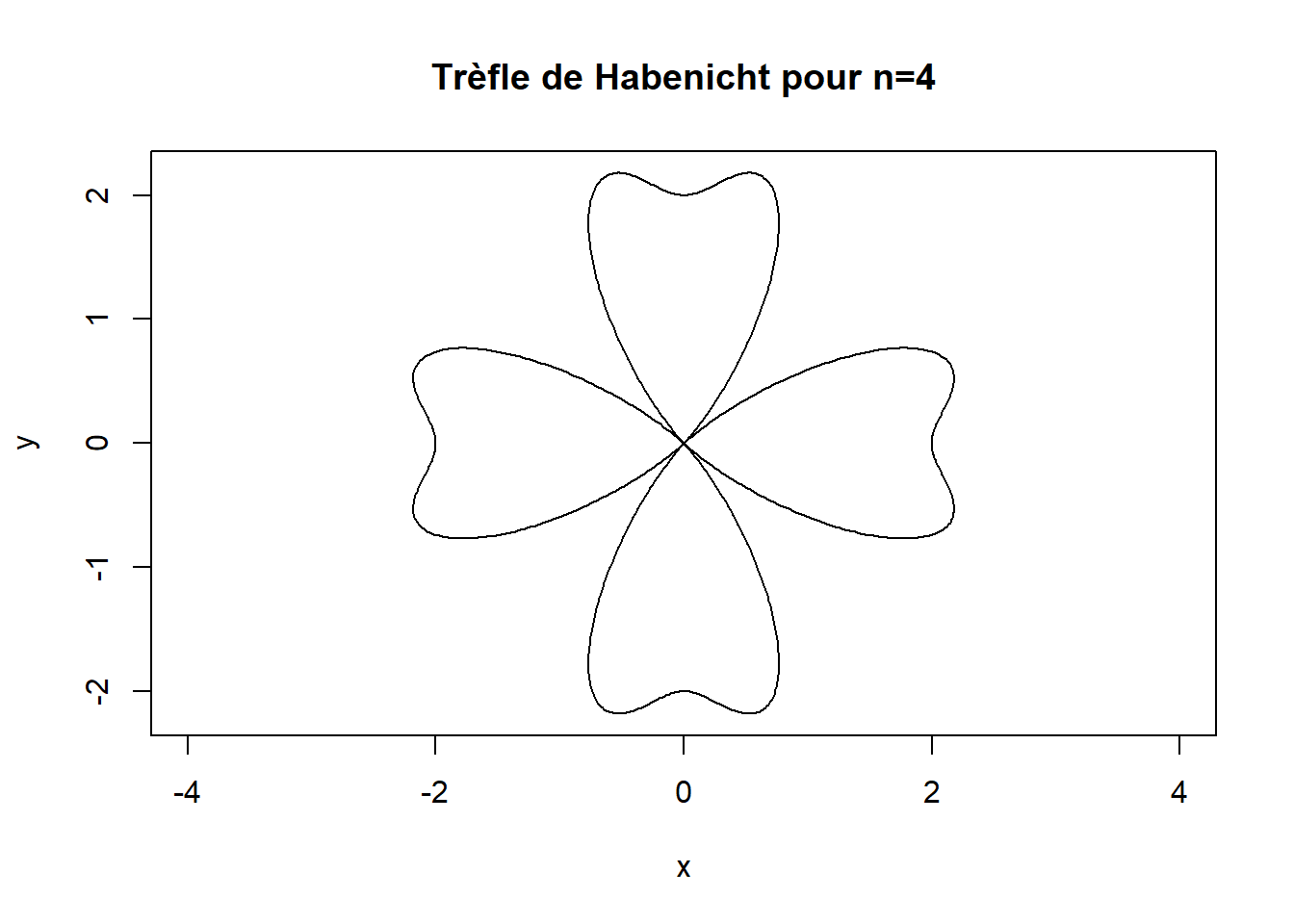
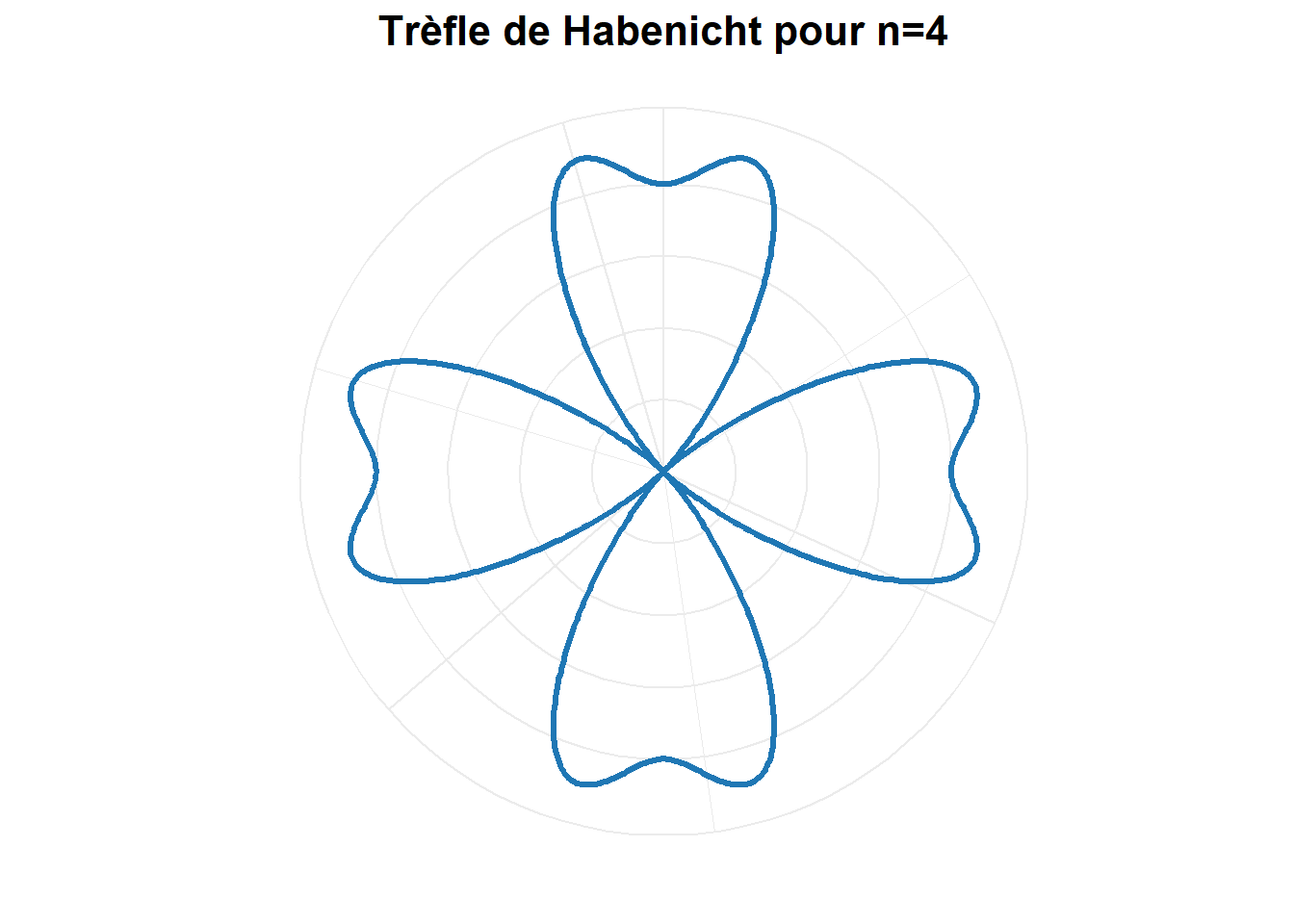
Une version plus soignée avec ggplot2 et des coordonnées polaires :
library(ggplot2)

theta <- seq(0, 2 * pi, length.out = 1000)
rho   <- 1 + cos(4 * theta) + sin(4 * theta)^2
data  <- data.frame(theta = theta, rho = rho)

ggplot(data, aes(x = theta, y = rho)) +
  geom_path(color = "#1f77b4", size = 1.2) +
  coord_polar(theta = "x") +
  theme_minimal() +
  labs(title = "Trèfle de Habenicht pour n = 4", x = "", y = "") +
  theme(
    plot.title = element_text(hjust = 0.5, size = 16, face = "bold"),
    axis.text  = element_blank(),
    axis.ticks = element_blank()
  )
Mise en forme par Antoine Géré.